

Biodiversity
Short for biological diversity, refers to the variety of life, including diversity within species, between species, and of ecosystems. It includes plants, animals, fungi, microorganisms, and the habitats and ecological systems they form.
CO2
This is the scientific formula for Carbon Dioxide. It is a gas which is released through the burning of fossil fuels, deforestation and human activity.
Carbon Footprint
A carbon footprint is the total greenhouse gas emissions caused directly and indirectly by an individual, organisation, product, event, or activity. It is usually measured in carbon dioxide equivalent (CO2e).
Carbon Offset
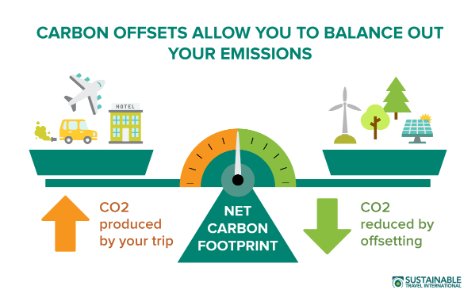
Offsetting is where a company or individual may purchase carbon credits, enabling them to invest in or fund projects that do good for the earth, such as reforestation, renewable energy, peatland restoration, etc. Carbon offsetting involves paying for verified projects that reduce, avoid, or remove greenhouse gas emissions elsewhere, in order to compensate for emissions that have occurred. Offsetting should complement, not replace, direct emissions reduction, and credits should be purchased through reputable verified schemes.
Flights are the main source of emissions, but can include driving and hotel stays. Credits and emissions are calculated by CO2 per tonne.
It is important to note that offsetting carbon does not remove it from the atmosphere; activities will have already emitted carbon into the atmosphere, offsetting simply acts as a ‘good deed’ to enhance methods of carbon removal in future.
Source: Sustainable Travel International
Climate Change
This is defined as the long-term change in the earth’s temperature caused by human activity such as burning fossil fuels, deforestation, industrial processes and waste disposal.
Circular Economy
This is a model that is designed to minimise waste, by keeping items in use for as long as possible. This can include clothing and textiles, electronics, furniture and many more resources. To keep items in circulation, the model focusses on repairing / refurbishing items that are broken or damaged, reusing items (perhaps using an empty coffee jar as a stationery holder), and recycling, where old materials are turned into new products. Composting also falls under the recycling model, where organic waste turns into fertiliser.
In our personal lives, we could consider selling clothes on Vinted or donating items to charity. As sporting organisations, we can consider setting up clothing donations in-house, so training tops, shorts, boots and other items that are still in usable condition can be used by those who may not otherwise be able to participate in activities.
ESG
ESG stands for Environmental, Social and Governance, and is a framework used to measure an organisation’s environmental impact (carbon footprint, waste management, greenhouse gas emissions, etc.), societal impact (labour, equality, diversity and inclusion, health & safety, etc.) and ethics and risk management (practices and procedures that govern an organisation)
GHG
GHG stands for Green House Gases – these are a collection of gases including:
- carbon dioxide (CO2)
- methane (CH4)
- nitrous oxide (N2O)
- fluorinated gases (F-gases) – these are man-made gases, primarily used in refrigeration and air-conditioning
These gases trap heat in the atmosphere, causing the temperature to increase. This is commonly known as Global Warming.
Greenwashing
Businesses may publish misleading information about the environmental performance of their organisation, product or service, to present a more positive public image.
The primary example of this is VW ‘Dieselgate’ Scandal in 2015, where Volkswagen installed software in its vehicles to cheat emissions tests, making them appear compliant with environmental standards. A further example is in 2019, McDonalds replaced their plastic straws with paper straws, which were then found to not be recyclable.
Net Zero
This refers to balancing the amount of GHG emissions produced by human activity with the amount being removed from the atmosphere.
Potency / Global Warming Potential (GWP)
In terms of climate change, potency refers to the ability of a specific greenhouse gas to trap heat in the Earth’s atmosphere, compared to carbon dioxide (CO2). Some gases are more potent (stronger / more harmful to the atmosphere) than CO2, even when emitted in small amounts. The timeframe for measurement is usually 100 years. For example:
- Carbon Dioxide (CO2): 1
- Methane (CH4): 28-32 (28-32 times more potent in the atmosphere than CO2, over 100 years)
- Nitrous Oxide: (N20): 265 – 298 (times more potent than CO2 / 100 years)
- Fluorinated gases F-gases: up to 23,500 (times more potent than CO2 / 100 years)
SDG
SGG stands for Sustainable Development Goals. These were adopted by all UN Member States in 2015. There are 17 goals, underpinned by 169 targets, making it a comprehensive list of actions, with the aim of achieving ‘peace and prosperity for people and the planet’
Read more: https://sdgs.un.org/goals
Contact
For more information about how we can support your organisation to be more sustainable, please contact Rebecca Stokoe, our Environmental Sustainability Development Manager:
